A water-efficiency duty, no meters, and a regulator that needed numbers
In 2009 the Climate Change (Scotland) Act told Scottish Water to promote water conservation and water-use efficiency. The economic regulator, the Water Industry Commission for Scotland, needed to know what that could cost and what it would save before it could set prices that allowed the investment. Almost no Scottish trial data existed, so the dissertation built the case from household surveys, 237 local water resource zones, and efficiency trials in England, Australia and the United States.
The journey
Tap a stop.
Inside the dissertation
The dissertation has eight chapters and is not published online. The Edinburgh MSc came before it and has its own tab, Before the MPhil.
Water use in Europe and the UK, and what makes up a household's demand
Three questions: what has worked for other water utilities, what efficiency would cost and save in Scotland, and what stands in the way
The hard and soft paths, the link between water, energy and climate, and how households, labels, meters and trading change demandWater, energy, carbon → 4Applied water efficiency
What utilities in California, Victoria and the UK saved, and at what costAbatement curves → 5Water management in Scotland
Who uses the water, and where it costs the most to deliverScotland's water → 6Domestic demand reduction in Scotland
Toilets in detail, showers by mail order, then the whole countryToilet calculator → 7Discussion
The institutional barriers, and three recommendations: social housing, business customers, and carbon credits for hot water savedWhat to do → 8Conclusions
Social housing and the costliest megazones first, then a national water label, a partner in energy, and better dataWhat to do →
"We need to incentivise demand to meet supply, as opposed to build supply to meet projected demand."Lee Pearson, MPhil dissertation, Chapter 3
Before the MPhil: a Ugandan village, then the water hidden in trade
Lee came to Cambridge with two things behind him. At Duke, civil and environmental engineering and Engineers Without Borders had taken him to RASD, a rural NGO in Nkokonjeru, Uganda. The first Marshall year, at Edinburgh, put numbers on the water and land hidden in a country's food trade. The MPhil turned the same habits on homes in Scotland: measure the resource, then ask what saving it is worth. Each has its own page.
Engineers Without Borders and RASD in Uganda
Lee joined Duke's Engineers Without Borders design team in 2005 and was the chapter's president in 2006. It worked with RASD, the Rural Agency for Sustainable Development in Nkokonjeru. On a Saxe Memorial Fund internship in 2007 Lee went back: the resource centre the chapter had helped build was finished, and a nut sheller he tested "worked quite well at de-pulping coffee". From November 2009, alongside the MPhil, he kept the link going as Engineers Without Borders UK's placement manager for RASD.
What a crop carries across a border
A linear programme of Germany's 47 main crops that worked out what the country should grow, import and export to earn the most from trade, or to use the least water or the least land. The three goals pull in very different directions. The dissertation was submitted in August 2009 and awarded with Distinction, and its idea of trading water savings the way carbon credits are traded came back in the Cambridge dissertation.
Most of the carbon in water is in your hot tap
89% of the carbon from water use happens inside the home, heating it, and only 11% at the utility. About 40% of home energy use goes on hot water. So a water-efficiency programme is also a carbon programme, and the dissertation argued it should earn carbon credits like one. Build a household below to see its water and carbon footprint.
Habits from UKWIR's estimates (Ashton et al., 2009), in litres saved per household per day:
Uses per day and litres per use: WRc identiflow metering of 447 British homes (Waterwise, 2009; Appendix A). Carbon and energy factors from the dissertation: 0.747 tCO₂e per ML of water supplied, 8 tCO₂e and 44,000 kWh per ML of hot water (Waterwise, 2010). Household sizes are scaled from the metered average, and the page counts showers and baths as hot water and half of indoor tap water as hot; those are this page's simplifications, not the dissertation's.
Across Scotland
Tables 17 and 18 of the dissertation.
Abatement cost curves: the cheapest litre first
The same tool that consultancies were then using to rank ways of cutting carbon, applied to water. Each block is one measure: its width is how much water it saves, its height what each megalitre saved costs. Read left to right and you have a shopping list for a utility. Blocks below zero pay for themselves, usually through the energy saved on hot water.
Costs differ by orders of magnitude
In Victoria the most expensive rebate cost 4,239% more per megalitre than the cheapest. In South East England, subsidising white goods cost 2,040% more than a cistern displacement device. Picking the right measures matters more than spending more.
The biggest use, the least behaviour
Toilets are about 30% of household use, and people don't flush more because a toilet is efficient. Showers are different: a low-flow head might just mean a longer shower, the "rebound effect" familiar from energy efficiency.
Who uses the water, and where it costs the most to deliver
Household data from the regulator let the dissertation split Scotland two ways: by the kind of household (the ACORN classification of neighbourhoods) and by geography (237 water resource zones grouped into 16 "megazones"). The two views point at different targets.
Households: wealth drives use
Data: WICS (2010), Figures 16 and 17 of the dissertation. City Lifestyle and Affluent Families values are from the text; the others are read off the chart and rounded.
27% of households can't reach the target with gadgets alone
The government target was 130 litres per person per day. A United Utilities trial suggested that retrofitting can bring a home down to that level only if it starts below about 339 litres a day. Three groups, Settled Families, Older Prosperity and Affluent Families, sit above that line. For them, devices are not enough; behaviour has to change too.
The largest single group is the Traditionally Comfortable (18% of households), so it drives total demand, even though Affluent Families use the most per home: 399 litres a day against 258 for City Lifestyle households.
Places: small zones cost more
Data: cost aggregated by the author from WICS (2010) data for each of 237 water resource zones (Table 3); demand from Scottish Water's 2009 Water Resource Plan. Per-person demand includes business use and leakage.
Central Scotland, £21 per ML
Edinburgh and Glasgow share one megazone that delivers 1,265 ML a day, more than half of Scotland's supply. Scale makes its water cheap, so saving it is hard to justify on cost alone.
Wick, Fife, Argyll & Bute
Plotting cost against volume, these three sat furthest above the trend line, making them the best places for a first trial. Argyll & Bute also had the highest demand per person in Scotland, 634 litres a day.
Flat fees blunt the signal
Households paid about £324 a year whatever they used. In four zones it cost more to supply the water than customers paid for it, yet without meters no customer would see a penny from saving.
The toilet calculator
Toilets were the one device Scotland had data for: housing surveys record when each home was built, and the age of a home predicts the size of its cistern. 13-litre cisterns survive only in homes built before 1965, and since 2001 new toilets have been limited to 6 litres a flush. The dissertation priced the "cost of conserved water" for swapping each one for a dual-flush toilet, then compared it with what each megazone pays to supply water. Change the assumptions and see where the swap pays.
Defaults are the dissertation's Table 7: 11.52 flushes a day per home (WRc metering of 447 British households), 3.5% Treasury discount rate, £40 installation (Environment Agency). Retrofitting a dual-flush kit costs about the same as "natural replacement".
Green: the megazone's average cost of supply is above the cost of conserved water, so the swap saves money overall. The dissertation's own result for 13 L toilets, natural replacement, 2.95 L: £82.19 per ML, viable in eight megazones, under £500,000 of investment for 500 ML a year and an 8.5-year payback.
Scaling up
112 ML a day for £82M
Replace the 13 and 9 litre toilets and fit dual-flush kits to the 7.5 and 6 litre ones, and Scotland saves 112 ML a day, 13% of household demand. Replacing every toilet outright saves the same water for £215M.
£3.9M for 4 ML a day of hot water
Copying United Utilities' mail-order showerhead offer (8% uptake, flow cut by 41%) saves little water but 64,000 MWh of energy a year, worth about £4.2M to households. The utility pays; the customer saves.
15% for £332M
Toilets, showerheads and taps in every home, at the English trials' average of £142 a home, take household use from about 150 to 127.5 litres per person per day.
From the hard path to the soft path
For a century water management meant dams, pipelines and treatment plants built to meet forecast demand, the "hard path". The dissertation argued for the "soft path" of demand management, efficiency and decentralised systems, and named the incentives that keep utilities on the old one.
Regulators can punish saving
Utilities are benchmarked on efficiency, and efficiency comes from pumping more water through the same pipes. A study of 52 Australian utilities found water restrictions lowered their measured efficiency. The dissertation asked WICS and Ofwat to check that their models don't penalise utilities for conservation.
Labels nobody recognises
Australia's mandatory water rating covered over 9,600 products; the UK's voluntary Waterwise Marque covered about 60. 65% of people surveyed wanted efficient taps and showers, but only 30% knew where to buy them.
Eight recommendations
Test your intuition
A year of Engineering for Sustainable Development
The MPhil in Engineering for Sustainable Development brought engineers from around the world together for one year of courses and a research dissertation with an outside partner. Lee came to it as a Marshall Scholar, straight from the ecological economics MSc in Edinburgh, while also managing Engineers Without Borders UK's placements with a rural Ugandan NGO.
An essay on carbon capture, January 2010
For the Globalisation paper, Lee asked whether carbon capture and storage could solve global warming. The conclusion: a critical part of the mid-term transition, worth perhaps 10 to 30% of the reductions needed, and only if policy puts a stable price on carbon and governments fund full-scale demonstrations. A decade later, carbon prices and credible removals were at the centre of Lee's work.
Engineers Without Borders UK in Uganda
From November 2009 Lee was EWB-UK's placement manager for RASD, the Ugandan NGO he had worked with since Duke. From 2010 to 2013 small teams of engineering students went to Nkokonjeru to help coffee farmers, first studying their farms and then designing low-cost machines to process coffee near the farm.
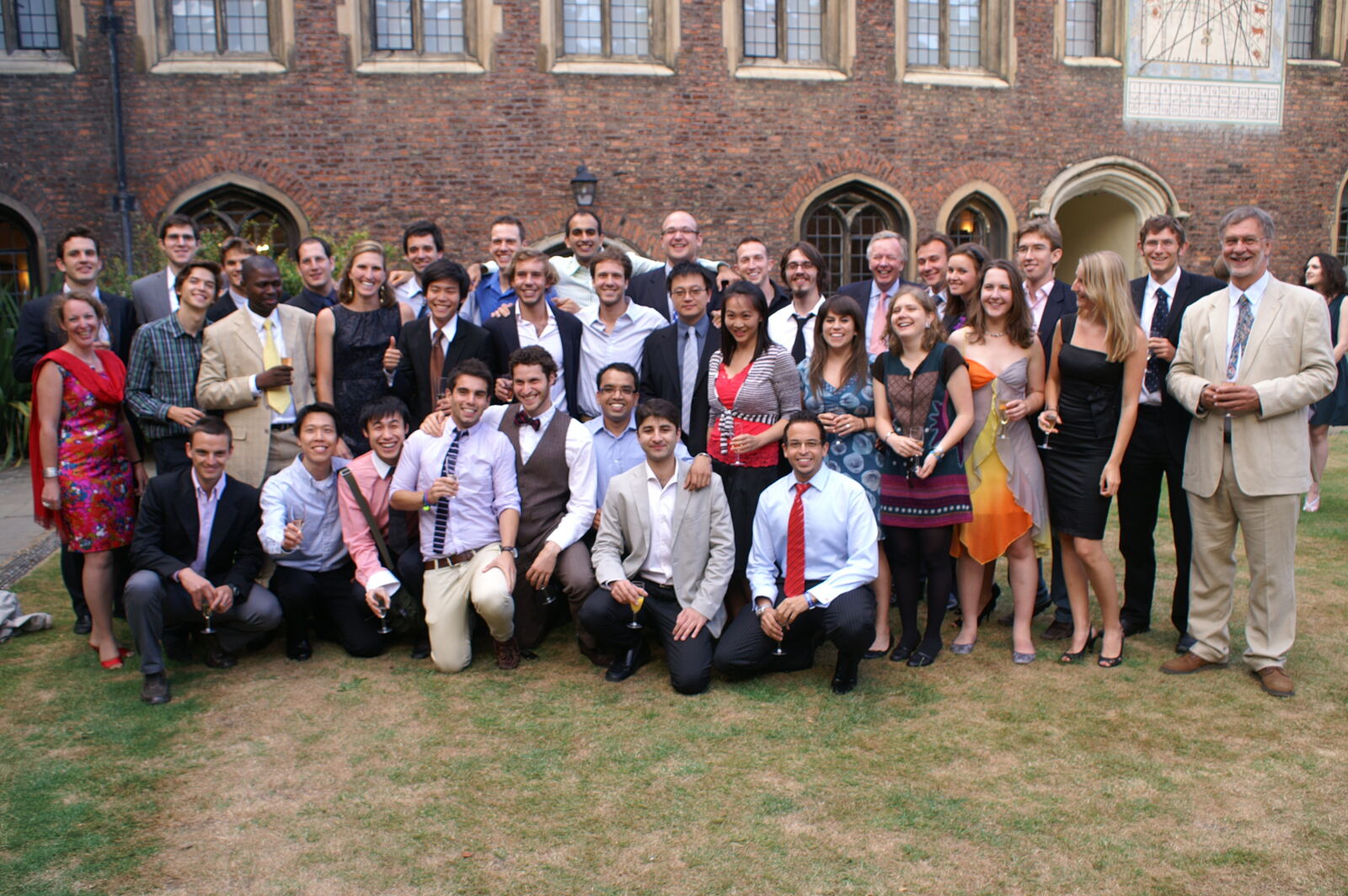
Graduation, July 2011
The degree was conferred in the Senate House in July 2011, during Lee's Fulbright year in Australia, with family there for the day.



Photos by Lee Pearson and friends, 2011. Tap a photo to enlarge it.
Footprints, incentives, and the people who decide
Each degree took the same question one step further. Edinburgh measured the water hidden in what countries trade. Cambridge asked how to price and pay for saving it at home, and found the carbon riding along with it. Imperial asked who sets the rules for trade and who carries the risk. The thread runs on into Wovoka: measure the resource, price what saving it is worth, and design the incentive so the people who do the saving are the ones who get paid.
A saving only happens when someone is paid for it
Scotland's water could be saved for less than it cost to supply, yet nobody had a reason to save it: no meters, flat fees, and a utility that would lose revenue. The fix the dissertation proposed was to stack the benefits, water, energy and carbon credits, and to send them to whoever does the work. That is the same design problem as paying landowners for the carbon their forests hold.
The bridge: from the MPhil to Wovoka
Each step after Cambridge took the same question further: what is a saving worth, and how does it reach the person who makes it?
- August to November 2010
Mirzayan Fellowship, National Academies
Weeks after submitting the dissertation, Lee started a Mirzayan Science and Technology Policy Fellowship at the National Academy of Engineering in Washington DC, helping to start a Roundtable on Science, Technology and Peacebuilding with the US Institute of Peace, and wrote a policy brief, addressed to the State Department's senior adviser for innovation, on user-generated content in peacebuilding.
From the MPhil: research written for the people who set the rules, as the dissertation was written for a regulator.
- 2010 to 2013
Coffee near the farm
As Engineers Without Borders UK's placement manager, Lee sent small teams of engineering students to RASD in Nkokonjeru, Uganda. They designed low-cost machines so coffee farmers could process their coffee near the farm, rather than dry all of it and rely on traders.
From the MPhil: a saving, or a better price, only counts when it reaches the person who does the work.
- April 2011 to April 2012
Fulbright Scholar at the Australian National University
A year in Canberra with Dr. Emma Aisbett, building a database of the food-safety and plant-health (SPS) rules that countries notified to the WTO from 1996 to 2010. It became the second chapter of the PhD.
From the MPhil: when the data does not exist, build it, as the dissertation did for Scotland's homes.
- 2011 to 2015
Imperial College London PhD
Risk in agricultural trade at the Centre for Environmental Policy: who writes the health rules of world food trade, who wins the disputes in Geneva, and how coffee farmers and traders in Uganda handle risk. Awarded in January 2015.
From the MPhil: once a saving has a price, the next question is who carries the risk.
- 2022 to 2023
Atrium Energy, Johnson Controls
As an entrepreneur in residence at Johnson Controls, Lee won executive approval to launch a spin-out, Atrium Energy, to bring energy savings and climate benefits to mid-market buildings.
From the MPhil: the Cambridge question again, how to make saving a resource pay the person who does the work.
- 2022 to now
Wovoka
Lee co-founded Wovoka and runs it from Manila: a nature-based solutions developer that works with landowners and communities, with a team in the Philippines.
From the MPhil: design the incentive so the people who do the saving, here landowners and communities, are the ones who get paid.