One year of following crops across borders
Germany buys and sells billions of dollars of crops a year, and each tonne carries the water and land used to grow it, somewhere. Lee's dissertation built a model of 47 crops and asked what Germany should grow, import and export if it cared about money, water or land. The answers pull in very different directions. Over the same summer he worked in a crop-protection lab in Germany, and by the end of the year he had written a proposal to send engineering volunteers to coffee farmers in Uganda.
The journey
Tap a stop.
Inside the dissertation
The dissertation has four chapters and is not published online. The Duke degree came before it and has its own tab, Before the MSc. The Bayer internship ran alongside it and has its own tab too.
Water economics and pricing, growth and water scarcity, and why they meet in the food tradeBig ideas → 2Review of virtual water as a water management tool
Where the idea came from, and a case study of the water in Germany's 2005 wheat tradeVirtual water → 3Linear programming optimisation of Germany's primary crop production and trade
Six plans for 47 crops: the best trade balance, the least water, the least land, and growing everything at homeRun the model →
The model's limits, the limits of virtual-water policy, and its politics
"The LP model presented is the first mathematical programming model for optimizing a virtual water (and virtual land) footprint for a nation."Lee Pearson, MSc dissertation, section 3.5, 2009
Before the MSc: an engineer who had already tried a coffee pulper
Lee came to Edinburgh from civil and environmental engineering at Duke, where two professors laid the groundwork for this dissertation. Henri Gavin "first exposed me to linear optimisation", the dissertation says, and Miguel Medina sparked "much of my interest in global water issues". At Duke Lee also worked with RASD, a rural NGO in Nkokonjeru, Uganda, and in 2007 found there that a nut sheller "worked quite well at de-pulping coffee". What came of that has its own page.
Engineers Without Borders and RASD
As president of Duke's Engineers Without Borders chapter, Lee helped RASD finish its resource centre in Nkokonjeru, then spent the summer of 2007 there on a Saxe internship, installing solar-powered computers and testing a nut sheller as a coffee pulper.
 Marshall Scholarship · 2008
Ecological economics, with the Scottish Agricultural College
The Marshall Scholarships, created by an Act of Parliament in 1953 to thank the United States for Marshall Aid, brought Lee to the UK. Edinburgh's MSc in Ecological Economics, run with the Scottish Agricultural College, treats the economy as part of the Earth's systems. Lee's supervisor, Dr. Neil McRoberts, later worked with him again on coffee research at UC Davis.
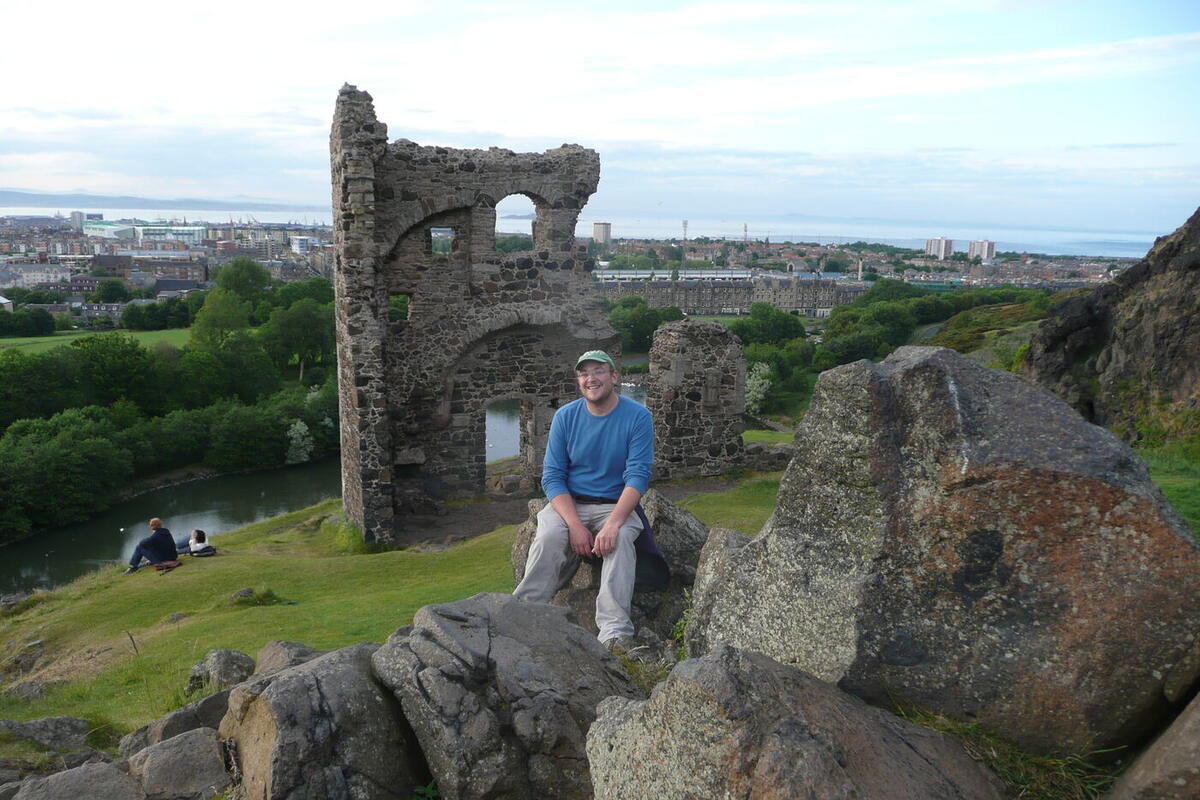
Lee at St Anthony's Chapel in Holyrood Park, Edinburgh, June 2009.
Ideas that sounded radical in 2008 are now rules
When Lee arrived in Edinburgh, counting the carbon, water and land behind what we buy was mostly the work of academics and campaigners. A planet with limits, and the Gaia picture of an Earth that regulates itself, were treated as green politics more than economics. Since then, as climate change has become impossible to ignore, the same ideas sit in reporting standards, trade law and company targets.
Three footprints
The MSc was about measuring all three. The dissertation focused on water and land; the course set them beside carbon.
Sources: ISO 14067:2018; IFRS S2 (ISSB, June 2023); Regulation (EU) 2023/956 (carbon border mechanism); EU ETS; ISO 14046:2014; Water Footprint Network; Richardson et al., Science Advances, 2023; SBTi FLAG guidance (September 2022); Regulation (EU) 2023/1115 (deforestation). "In 2008" lines: the dissertation, chapters 1 and 2.
"In the end, water use is lowered within the basin by the same quantity as if each company were to meet the required reductions individually; however, it is achieved at a lower cost. [...] This is the basic premise behind trading carbon credits (or in this case, water credits) in the first place."Lee's dissertation, 2009, section 2.6: water savings should be tradeable like carbon credits, against the rule that a company must first cut its own water use before buying offsets
The taught year: where the habits formed
Before the dissertation came six months of courses, from September 2008 to March 2009. Six pieces of Lee's coursework show the habits he carried into the dissertation and beyond: count first, be careful what you put a price on, and ask who carries the cost and who decides.
Shipping's carbon, estimated from the fuel bill
A group benchmark of three shipping groups, Maersk, K Line and NYK, on carbon per tonne of fuel and per dollar of earnings. Lee's files hold an early outline of the talk and draft slides on regulation and strategy that went into it: shipping sat outside the Kyoto Protocol and EU rules, and the group proposed cap and trade for the industry. The firms estimated their carbon from the fuel they burned and reported it in different ways, so the group asked for common reporting standards. Since 2024 the EU Emissions Trading System has covered large ships.
Discount the future, but not to zero
"Socially Optimal Discount Rate: Anything save zero" argued that refusing to discount would mean "subsistence level poverty for all generations", and that valuing nature properly, or setting limits on its use, does more for the future than changing the rate. A study had read farmers' soil-erosion choices in the Philippines as concern for future generations; Lee noted they might instead show "extreme risk-aversion to total loss". In his PhD he later measured coffee farmers' attitude to risk in Uganda with games.
Judge the road by the farmers
An essay on the logical framework, or log frame, the one-page table aid agencies use to plan and monitor projects, through a World Bank road project in Rwanda that measured its rebuilding of the Kigali to Ruhengeri road by the road's roughness. "While road roughness makes the most sense to someone trained as a civil engineer (as is this author), it is easy to see the logic of using a farmer quality of life indicator", since better lives for farmers were the point of the project.
Measure, then weigh
An essay on weighing biodiversity against timber in Finland's forests with multi-criteria methods, which do not need everything in money. "We cannot manage that which we cannot measure, and importantly in CBA with a common monetary numeraire, we cannot value that which we cannot price." (CBA is cost-benefit analysis, which counts everything in one unit, money.) Tools that draw on local knowledge, he argued, matter most in the tropics, "where management partners are crucial". His reading that month already included REDD (paying countries to keep their forests standing) and payments for ecosystem services.
Restoration starts with what went wrong locally
A literature review of mangrove restoration in Kenya, Thailand and Florida. "The key is to understand local factors: importantly, the local cause of mangrove decline, and the local species which were naturally present." Planting trees alone gives plantations, not ecosystems; natural regeneration should come first, and "it is critical to involve the community". Here he was wary of prices: it is "difficult (if not impossible) to put a price on living things."
Experts measure, society decides
Asked whether electricity from nuclear power is safer than from coal, Lee found that on lives and years of life lost it clearly is, then argued that this does not settle it, because people weigh a rare catastrophe differently from steady harm. "These judgments will be decided by society informed by experts, but not by experts themselves." Who sets the acceptable level of risk became a question of his PhD on food-safety and plant-health rules in trade.
Lee's MSc coursework, unpublished: "Shipping Industry Benchmark and Strategy" (group presentation, 13 November 2008); "Socially Optimal Discount Rate: Anything save zero" (1 December 2008); "The failures of log frames: as seen with World Bank transport project in Rwanda" (19 December 2008); "Multi-criteria Decision Making for Biodiversity: Applications in boreal forests of Finland" (16 February 2009); "Mangrove Restoration: A comparative international look" (24 March 2009); "Electricity generation from nuclear power safer than from coal" (31 March 2009). Shipping today: Directive (EU) 2023/959.
Test your intuition
Answers: dissertation pages 9, 21, 27 and 37 to 41.
Germany imported 1.4 million tonnes of wheat, and 1.4 billion cubic metres of water with it
Virtual water is the water used to grow something, counted wherever it ends up. Tony Allan coined the term in the 1990s; Arjen Hoekstra turned it into the water footprint in 2002. Lee applied both to the wheat Germany bought from 25 countries in 2005. German farms needed 757 m³ of water and about 0.13 ha of land per tonne. Most suppliers needed more.
Water per tonne of wheat. German farms: 757 m³. Red used more, green used less.
Dissertation Tables 2 and 3, from FAOSTAT 2005 trade and yields and Chapagain and Hoekstra's virtual water contents.
Saving one can cost the other
Poland's wheat used more land than German wheat, but saved more water than wheat from any other supplier. Belgium's was the reverse: high yields, thirsty fields. Across all 47 crops in the model, land and water use moved together closely (R² = 0.969), but not perfectly, and the gaps are where the choices are.
The other side of the ledger
Germany exported 4.6 million tonnes of wheat to 59 countries the same year. Because German yields are high, that saved the world about 4.2 billion m³ of water and 822,550 ha of land compared with the buyers growing it themselves. Net of imports, Germany's wheat trade saved 3.9 billion m³ and 743,000 ha.
Where the question came from
Virtual water meets linear programming
Lee's first note on a dissertation topic, on 25 February 2009, already proposed a linear programme of virtual water and trade, for a small island. On 9 March Christos Zoumides lectured the class on virtual water, the talk that "cemented" the choice. A week later, in a group presentation for the Applications in Ecological Economics course, Lee presented virtual water as a tool for "trade optimization (e.g. buy cereal, sell citrus)", and a classmate showed how a linear programme is set up in Excel.
From describing footprints to choosing them
Parts of Lee's course paper on virtual water in British Columbia went into the dissertation's section on water economics and pricing (pages 10 to 13). In British Columbia, local crop water figures differed from global averages by orders of magnitude, yet he concluded that counting beats not counting, and that the method, still "more descriptive than normative", could one day say "what the right or fair water footprint is". The dissertation named the gap: few studies are normative, "and even fewer are prescriptive about what 'the best' water footprint might be". The model was his first attempt to fill it ("a preliminary attempt", the dissertation calls it): it worked out the best plan for Germany under each policy goal, but made no claim about the "right" size of a country's water footprint or a fair share.
Lee's note on dissertation ideas, 25 February 2009; group presentation "Eco Eco of Water Resource Management", 16 March 2009; Assignment 2, "Virtual Water as an International and Local Water Management Tool: Case study of British Columbia, Canada", 23 March 2009, whose acknowledgement dates the Zoumides lecture; dissertation acknowledgements, pages 10 to 13 and page 54. All unpublished.
The same summer Lee met wheat again in a lab, as a carrier of disease rather than water. Bayer in Germany →
Run Lee's 2009 model in your browser
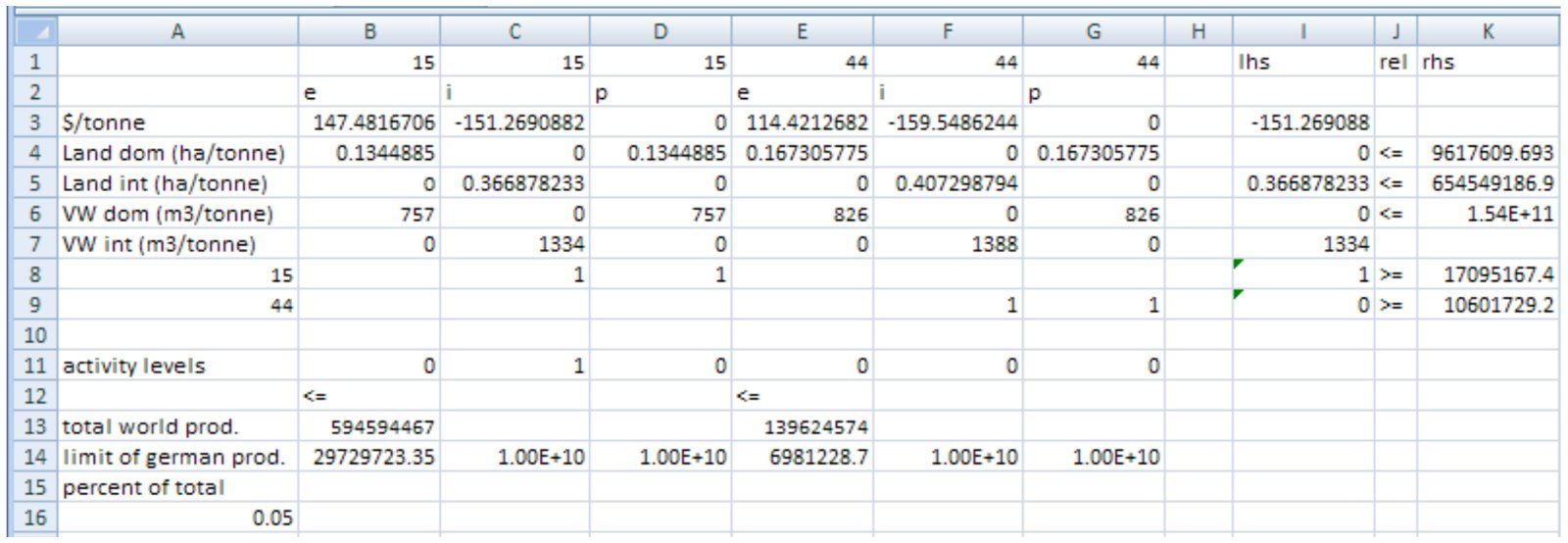
For each of 47 crops, Germany can grow for home, grow for export, or import. Every choice uses German or foreign water and land, and earns or costs dollars at 1997 to 2001 prices. The model meets German demand for every crop, stays within the farmland and farm water Germany actually used, and caps exports at the larger of 5% of world production or Germany's own harvest. Pick a goal and the solver finds the best plan. The dissertation called it the first mathematical programming model to optimise a nation's virtual water and land footprint.
Model rebuilt from the dissertation's data workbook (FAOSTAT 1997 to 2001; Chapagain and Hoekstra water contents) with the open-source javascript-lp-solver. It reproduces the dissertation's scenario results.
Money and water don't line up
Chasing the trade balance turned a $4.18bn deficit into a $33.28bn surplus: maize led exports by weight, at 30 million tonnes, while fresh vegetables earned 40% of the export income and barley took 40% of the import bill. But the total water footprint grew from 50.6 to 63.8 billion m³, and the land footprint from 12.5 to 18.9 million ha, because the imports were grown with more water and land abroad.
Self-sufficiency is expensive
Growing everything at home needs 11.2 million ha, about 95% of Germany's arable land, and 15% more German water than the baseline. Trade lets countries share out water and land; the question is on whose terms.
The least-water plan
Growing each crop where it uses least water cuts Germany's total water footprint by 8.5%, to 46.3 billion m³. Exports stop, so the trade balance is just the import bill: a $1.53bn deficit, against $4.18bn at baseline.
Findings: dissertation sections 3.3 and 3.4, pages 63 to 88.
Seven plans side by side
Each plan is the model's best answer to one goal. Tap a plan to load it in the model above.
Dissertation Tables 7 to 13, pages 63 to 74. Trade balance in US$ billions at 1997 to 2001 prices; water footprint in billion m³ and land footprint in million ha, at home and abroad together. Baseline is what Germany actually did, 1997 to 2001.
Where the footprint lands
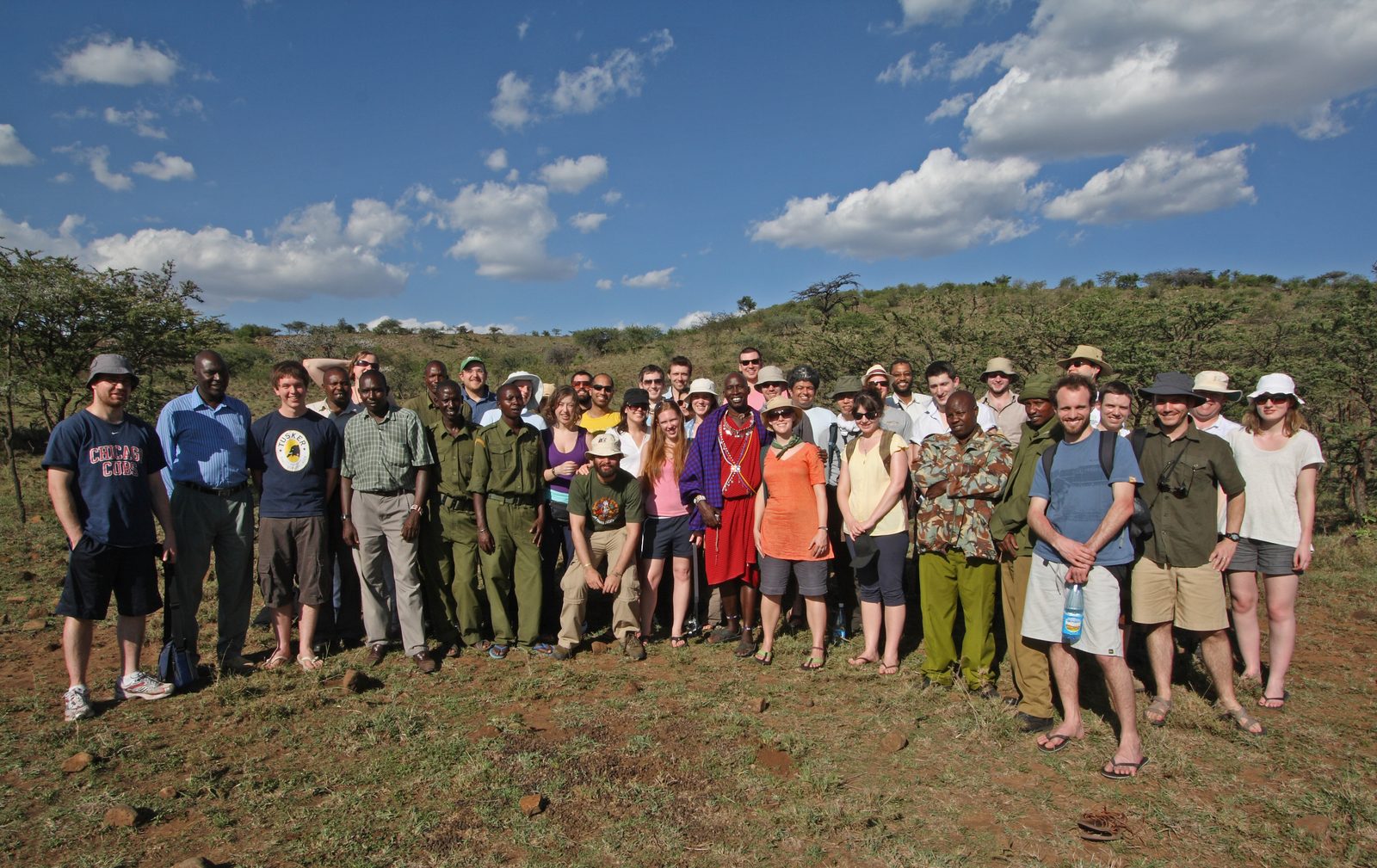
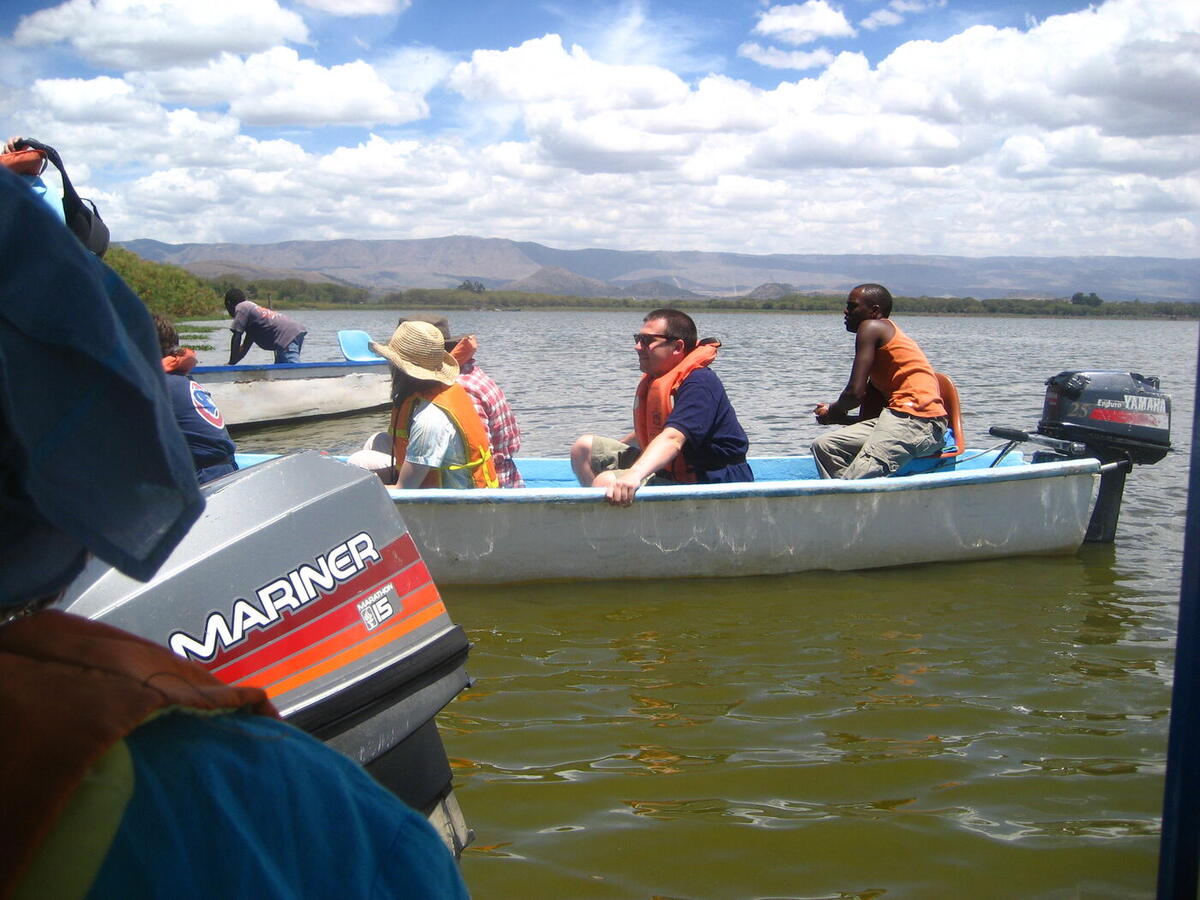
In April 2009 the class spent a week in Kenya, hosted by WWF Nakuru, to see the ecosystems that ecological economics tries to value: three days in the Masai Mara, then Lake Nakuru and Lake Naivasha in the Rift Valley. At Naivasha the plan included a flower farm, the dissertation's example of water carried away by trade: "The production of flowers for Holland can reduce the levels of Lake Naivasha in Kenya." Lee stayed on in East Africa for most of April, on the Kenyan coast and in Tanzania, including Zanzibar, and at the end of the trip visited Ignitius Bwoogi of RASD, his partner from Duke, in Nairobi. That December, Lee's first Engineers Without Borders UK proposal for RASD costed the volunteers' vaccinations from "my MSc programme's trip to Kenya".
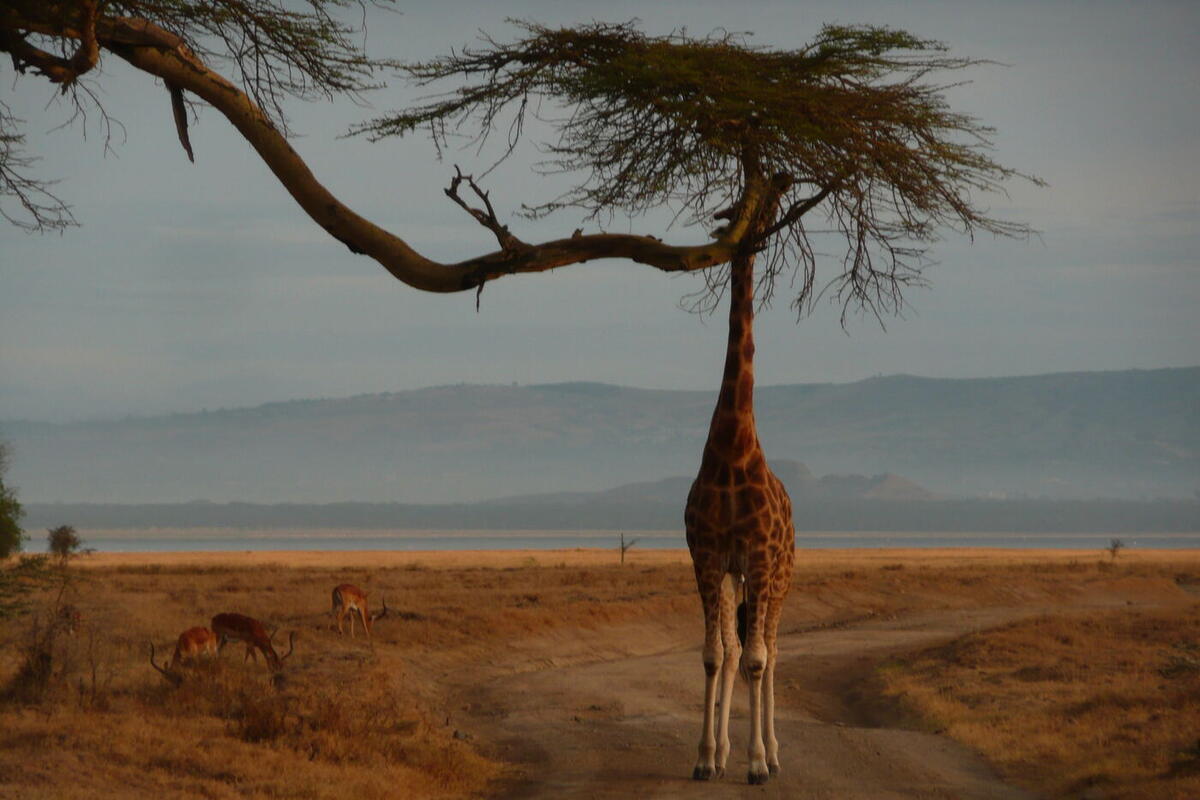
Who carries the footprint?
More than 70% of the freshwater people use goes to farming, and only about 0.007% of the planet's water is fresh and available for direct human use. When a dry country exports thirsty crops, the water is used up in the exporter's own rivers and aquifers, even though it counts in the importer's footprint. Consumers in the EU, the dissertation notes, are responsible for about a fifth of the drying of the Aral Sea through the cotton they buy. "Importing countries hardly pay the true costs to exporting nations."
The costs that prices miss
The dissertation's general discussion lists the drawbacks of a virtual-water policy: importing food can weaken a country's own farming "at the cost of jobs in farming and rural livelihoods", and unless prices reflect scarcity, the social and environmental costs fall on the exporting nations. From 2009 Lee worked on the other side of that ledger: helping coffee farmers in Uganda process more of their crop themselves.
Dissertation pages 9, 21, 22 and 103. Study tour: the programme director's tour handout and fieldwork risk assessment, January 2009. Lee's later travel and Nairobi visit: his photo folders, April 2009. The group photo is from a classmate's camera, in Lee's 2009 photo folders. Proposal: EWB-UK placement proposal for RASD, 8 December 2009.
The same wheat, seen as a trade risk
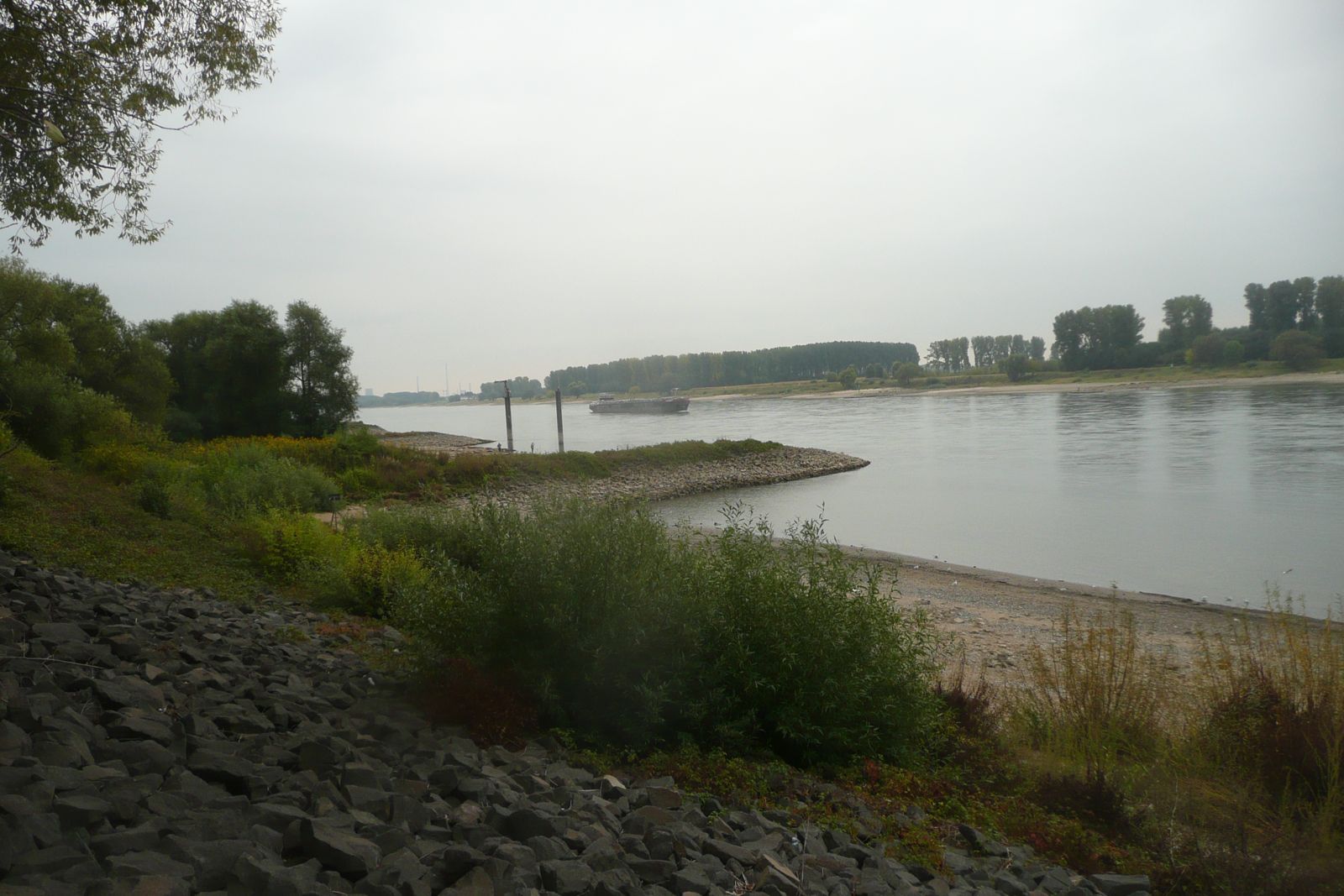
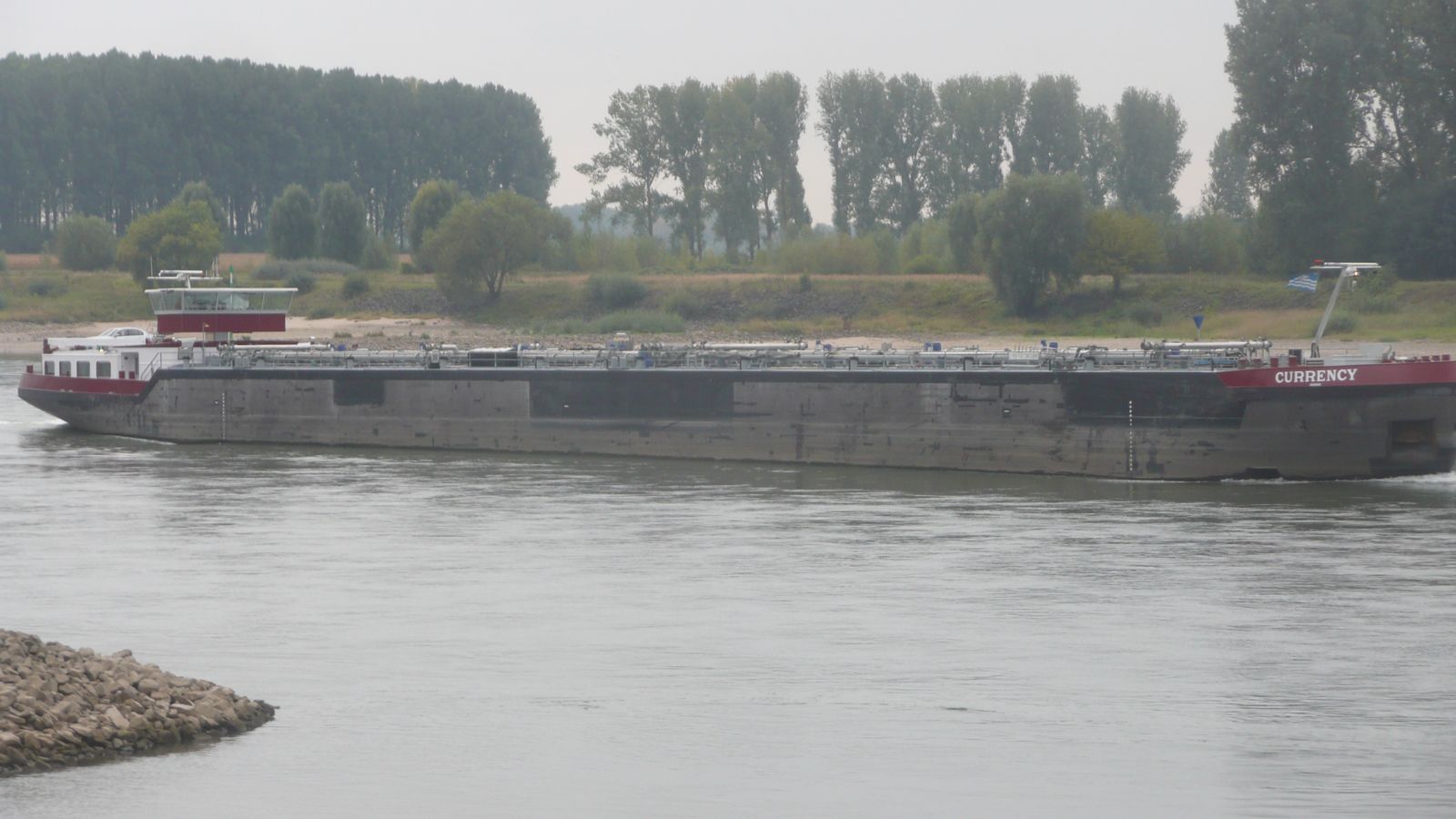
In 2009 Lee won a DAAD RISE Professional scholarship, the German Academic Exchange Service's programme of research internships in German companies. From 1 July to 30 September he worked in the fungicide research labs of Bayer CropScience in Monheim, on the Rhine between Düsseldorf and Cologne, in a group whose job was scientific support for Bayer's fungicides in development and on sale. Lab days started at seven. He started a new project on an emerging Alternaria fungus found in contaminated wheat samples from Ukraine, which, in Lee's words, "was spreading in the wheat supply from Ukraine and was going to affect global trade". He wrote the Edinburgh dissertation in the same months: "I was also working a full-time laboratory job at Bayer CropScience in Germany."
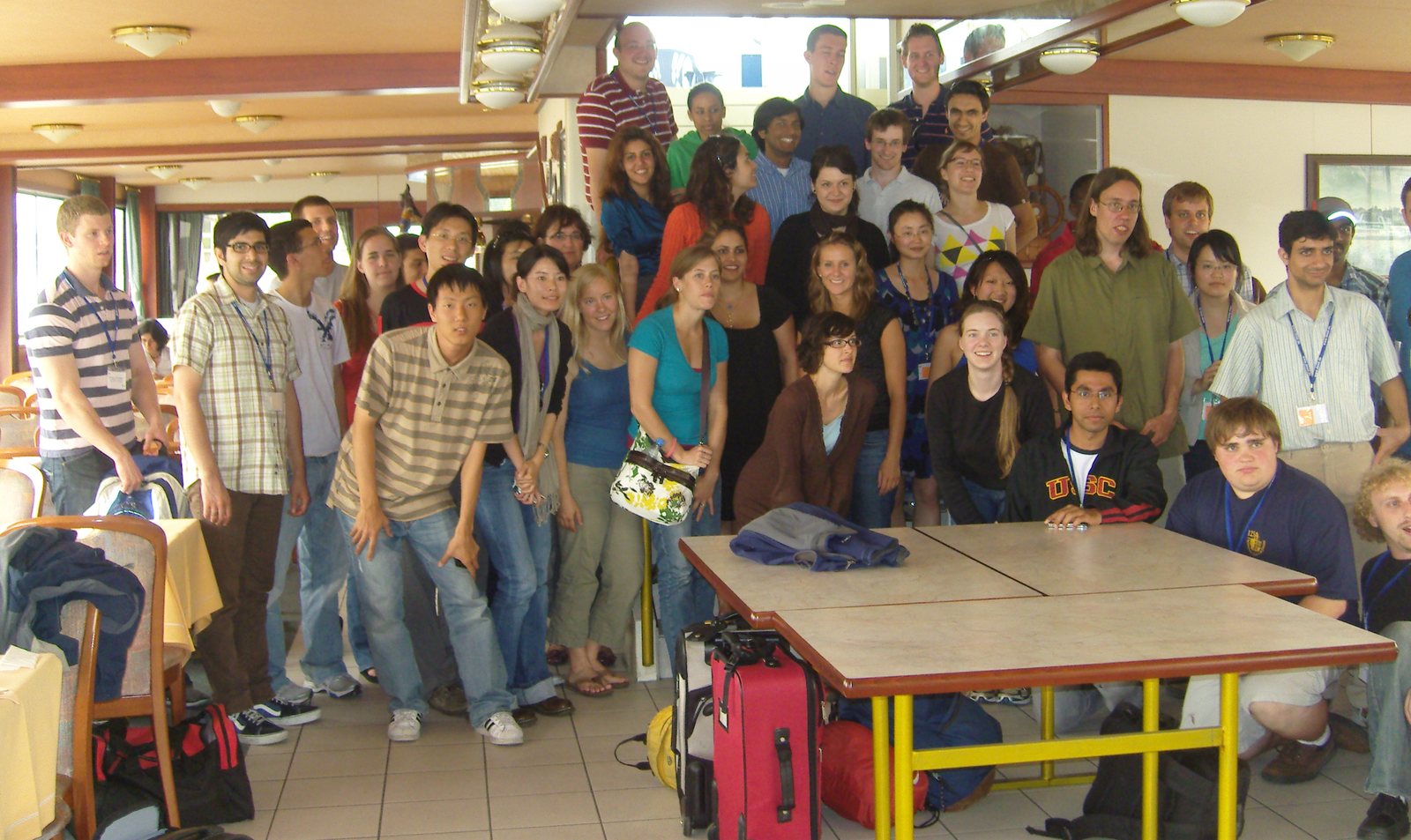
Alternaria in Ukrainian wheat
Alternaria is a mould that darkens wheat grain and can make its own toxins. Lee identified and isolated it from wheat commodity samples, grew it from single spores, and tested two compounds from Bayer's portfolio on its growth and on the mycotoxins it made: the poisons that decide whether grain can be sold as food. This page does not name the compounds or the results.
Disease is a trade problem too
Ukraine had a bumper harvest in 2008 and was exporting nearly 10 million tonnes of wheat. The EU sets maximum levels for contaminants in food, mycotoxins in cereals among them, so a toxin-making fungus spreading in a big exporter's grain is a risk to trade as well as to the crop. From 2011 Lee's PhD asked who carries that kind of risk when food crosses a border.
By day a disease risk, in the dissertation a water footprint
The lab job and the dissertation were meant to meet. In March 2009 Lee's case study was Spain; by May it was Germany, where he had a summer place in Bayer CropScience's labs, and his dissertation proposal asked how much water it would take to dilute the fungicides used on cereal crops to a safe level, the part of a water footprint called "grey water". That question never reached the dissertation, and the lab work went to Alternaria. Two views of one grain remained: in the lab, wheat in trade carried a fungus; in the dissertation, section 2.7, Germany's 2005 wheat imports used 31% more water than growing that wheat in Germany would have.
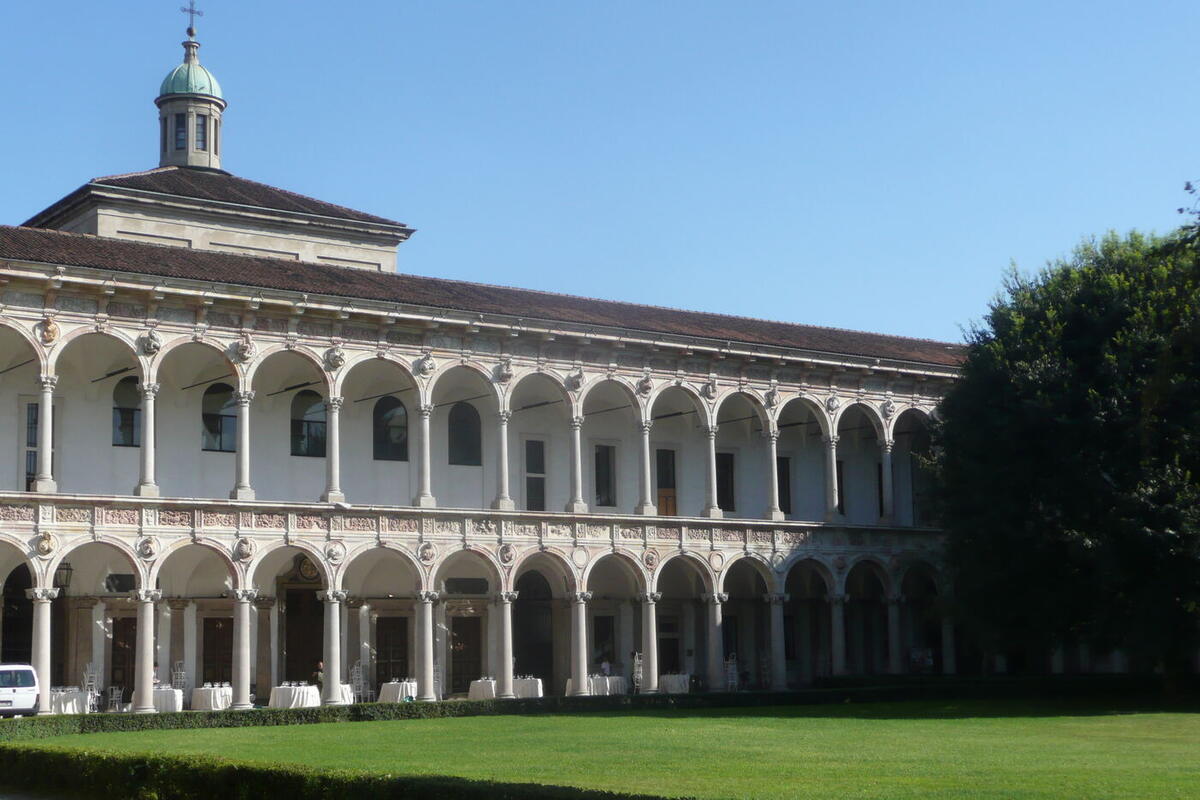 LERU BRIGHT conference · Università degli Studi di Milano · 27 to 30 August 2009
Food and water, argued in Milan
At the end of August, in the middle of the Bayer placement, Lee represented the University of Edinburgh at BRIGHT, the student conference of the League of European Research Universities (LERU), on "Food and Water: An Increasing Challenge". Experts gave the plenary talks; the students worked in six groups of about twenty, debating essays they had written beforehand. Lee was in the group on "Distributing across countries and continents", and his essay answered the question he was set: "Water supply: water privatization. Cui prodest?", Latin for "who benefits?"
The Università degli Studi di Milano, host of the conference, August 2009.
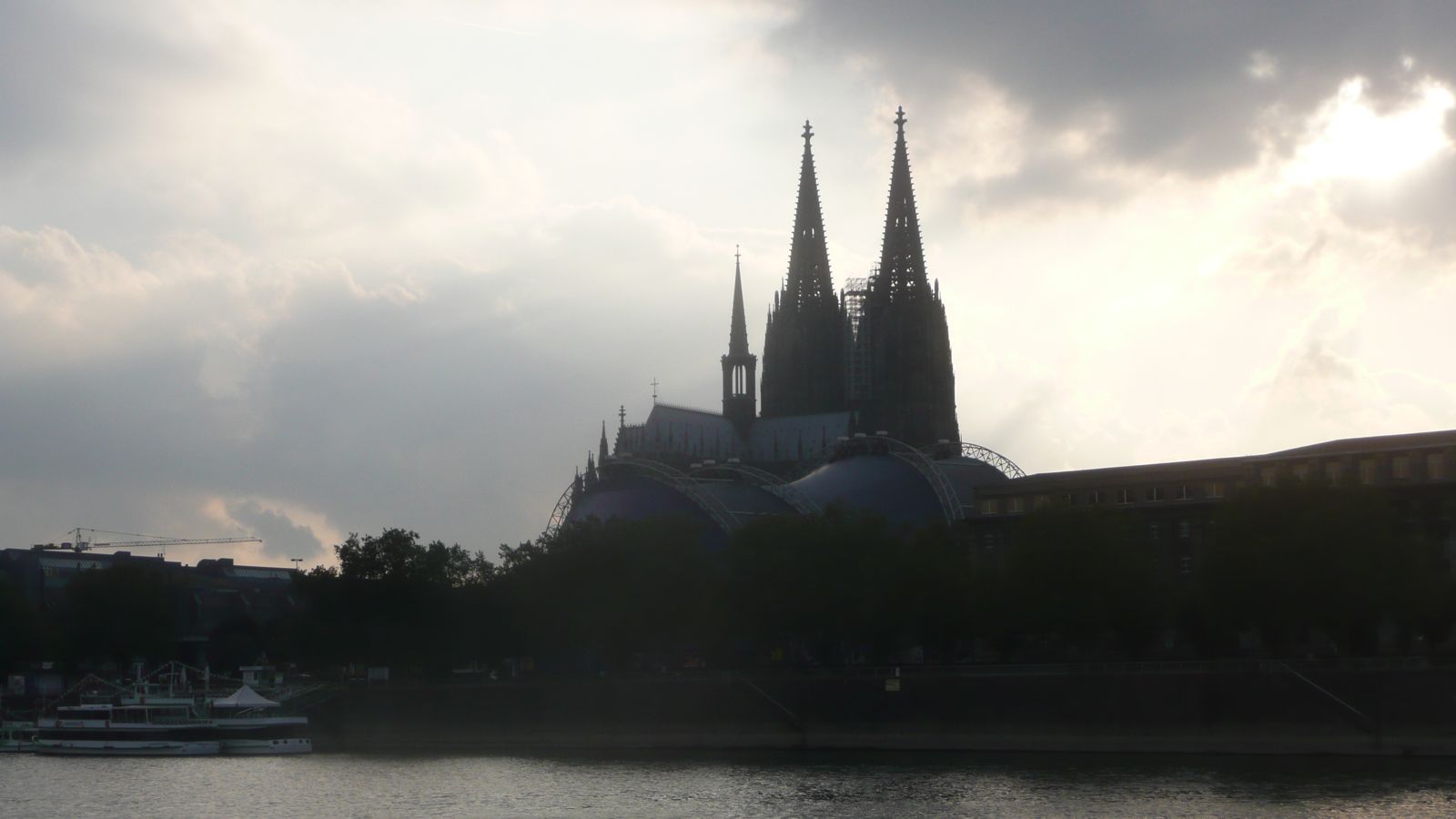
Monheim and the Rhine, September 2009
Sources: Lee's CVs, 2009 to 2014, and his placement letters and emails (private). DAAD RISE Professional. USDA Foreign Agricultural Service, February 2009. Commission Regulation (EC) No 1881/2006. BRIGHT: the 2009 conference programme, the working-group brief of 12 June 2009, Lee's essay and his summer 2009 plan. Why Germany: Lee's BRIGHT application statement (March 2009) and his dissertation proposal (headed 5 May 2009), both private. Photos by Lee Pearson; the group photo is from his album of the scholars' meeting in Bonn, June 2009.
Graduation, and where the questions went next
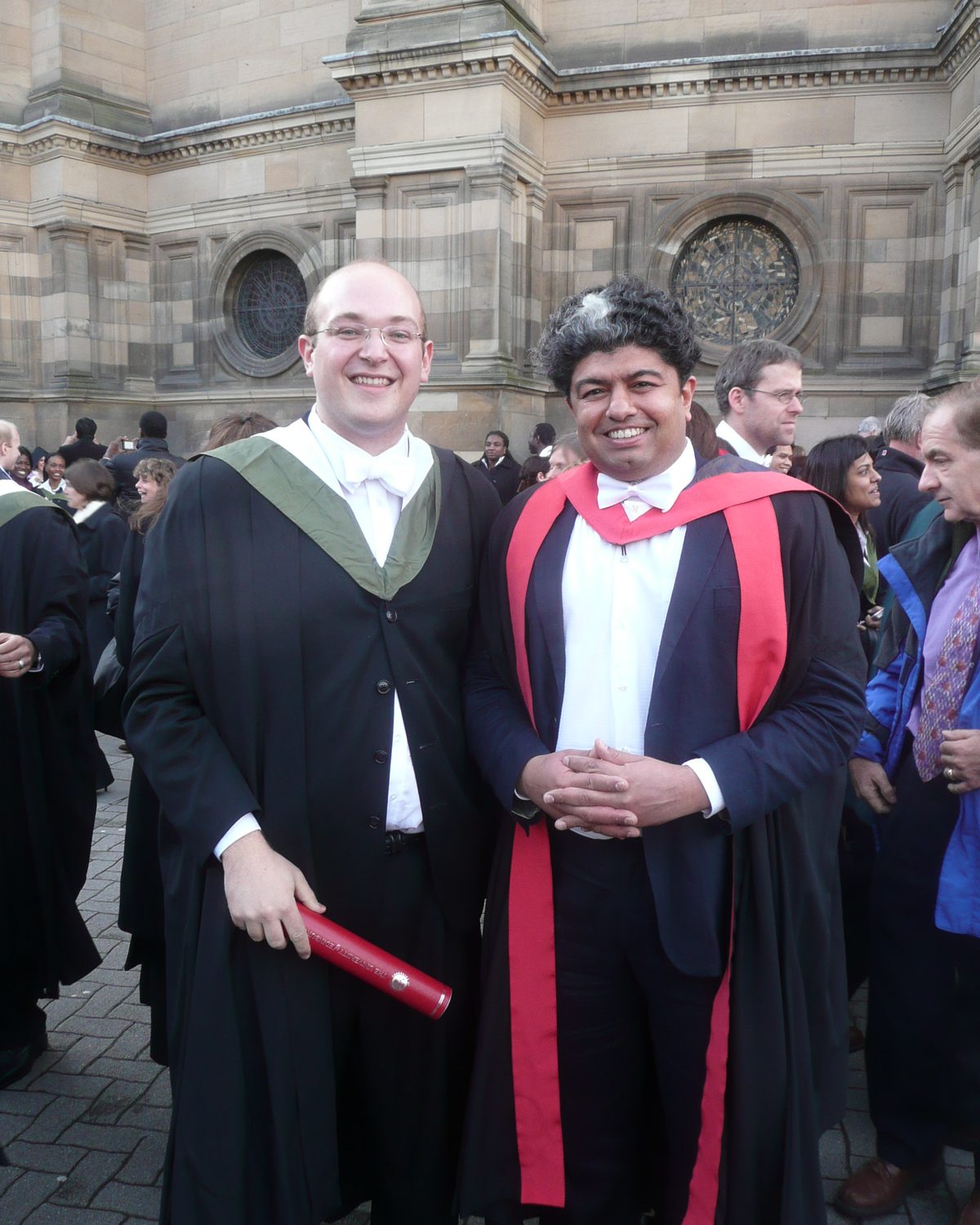
Lee finished the dissertation on 24 August 2009, in the middle of the Bayer placement, and it was awarded with Distinction. By October he had started the MPhil at Cambridge. He came back to Edinburgh to graduate in the McEwan Hall on 26 November 2009, the month he became Engineers Without Borders UK's placement manager for RASD.
Trade carries more than goods
The MSc asked what trade does to the water and land behind food, and the Bayer lab showed that grain can carry disease too. The Cambridge MPhil turned to saving water in Scottish homes. The Imperial PhD asked who carries the risk when food crosses a border, and ended with coffee farmers in Uganda.
Footprints became markets
The dissertation argued that water savings could be traded like carbon credits, so that the cheapest saver does the most. That idea, that environmental outcomes can be measured, verified and paid for, runs through Lee's later work in climate technology and nature-based projects, and through Wovoka today.
The model after Edinburgh
 EWRI Watershed Management Conference · Madison, Wisconsin · August 2010
The dissertation as a conference paper
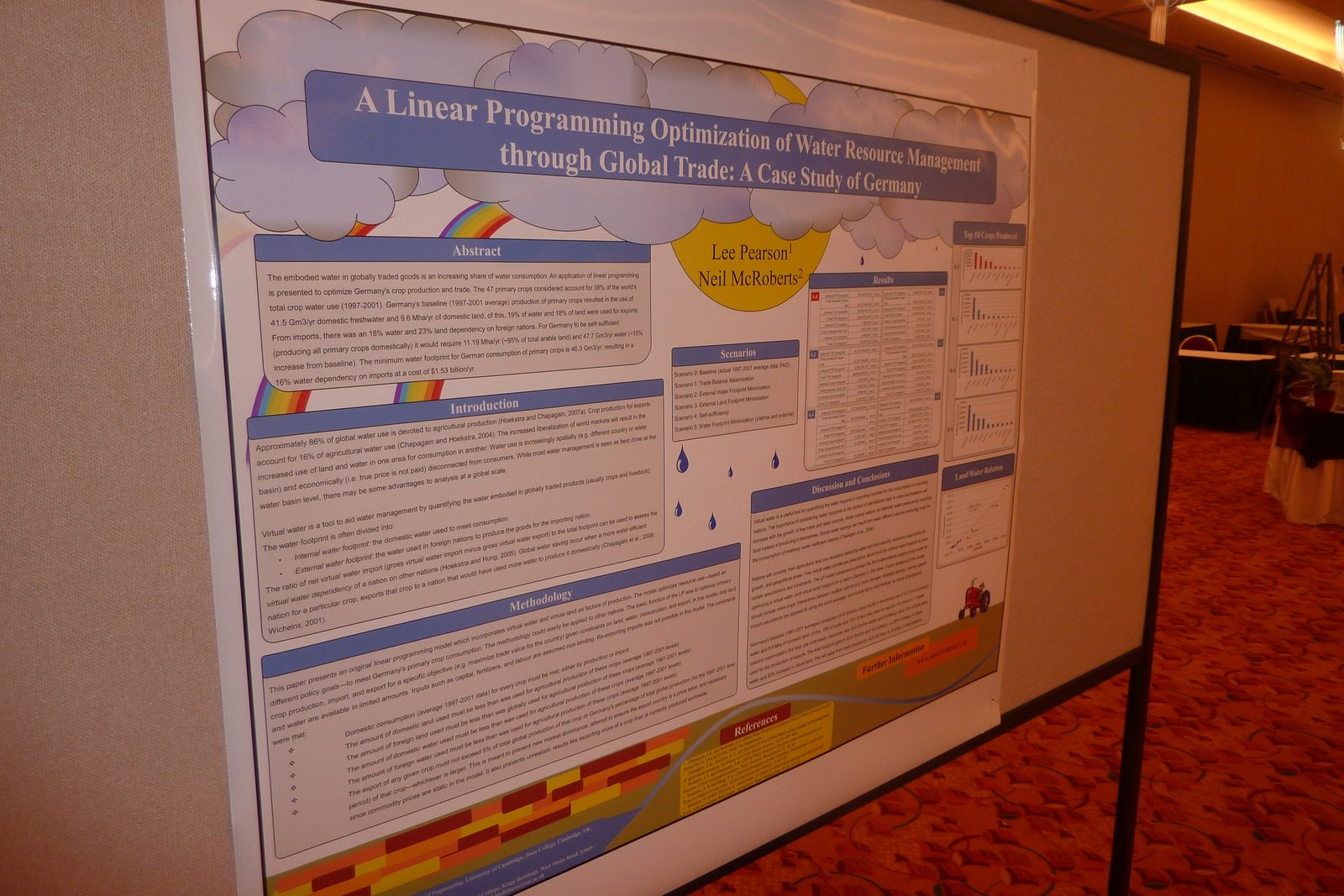
A year after submitting it, Lee presented the model as a poster and a proceedings paper with his supervisor, Neil McRoberts, at the Watershed Management Conference of the American Society of Civil Engineers' Environmental and Water Resources Institute, 23 to 27 August 2010. The poster led with the baseline: 19% of the water and 18% of the land Germany used for its primary crops went to exports, while imports left it 18% dependent on other countries for water and 23% for land. Three days after the conference closed, Lee started a fellowship at the National Academies in Washington DC.
The poster in the conference hall, Madison, August 2010.
Virtual water, back in the classroom
In January 2011 Lee talked about water footprinting on Science at 1, a radio show at Imperial College. Teaching trade and environment to Imperial's MSc students in March 2013 and March 2014, he gave a session on virtual water and water footprints: green, blue and grey water, the European Union's water footprint in cotton, and Arjen Hoekstra's national water accounts, with Hoekstra and Hung's 2005 paper as reading.
Sources: the EWRI 2010 poster and proceedings paper (Pearson and McRoberts); Lee's photos from Madison, August 2010; his report to the Marshall Commission, August 2011; his CV of January 2013; his Trade and Environment class slides and reading guidance, March 2013 and March 2014.
The bridge: from the MSc to Wovoka
Each step after Edinburgh moved the same question closer to the farm: what does a crop carry, and who is paid for it?
- 2009 to 2010
Cambridge MPhil
Engineering for Sustainable Development at Jesus College, with a dissertation on cutting water, energy and carbon in Scottish homes.
From the MSc: optimise for water, then ask who pays for the saving.
- 2010 to 2013
Coffee near the farm
As Engineers Without Borders UK's placement manager, Lee sent teams of engineering students to RASD in Uganda to design low-cost machines so farmers could process their own coffee.
From the MSc: the farm end carries costs that prices miss.
- 2011 to 2015
Imperial PhD
Food-safety and plant-health rules in world trade, disputes at the WTO, and risk games with coffee farmers in Uganda.
From the MSc's Bayer summer: health rules decide which crops cross a border.
- 2022 to now
Wovoka
Lee co-founded Wovoka and runs it from Manila: a nature-based solutions developer that works with landowners and communities, with a team in the Philippines and RASD as its partner in Uganda.
From the MSc: count what land and water provide, and make it count for the people who look after them.